

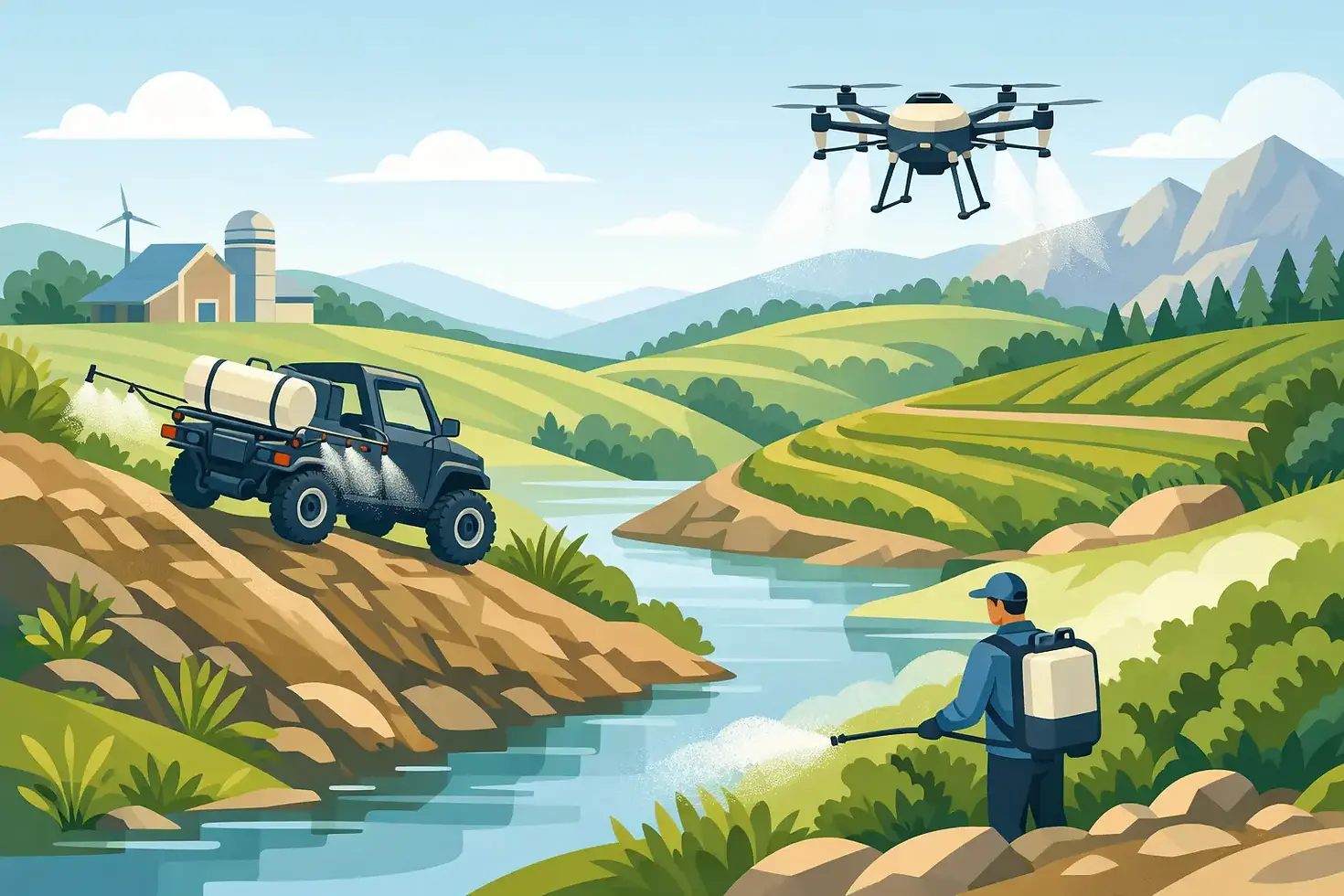
Farm Access Spraying for Hard-to-Reach Land
When a block is too steep for a tractor, too wet for tyres, or too awkward for a spray unit to reach efficiently, the job usually slows down or gets put off. That is where farm access spraying becomes a practical option. It allows landowners and managers to treat difficult areas without forcing machinery into places it should not be, and without sending staff into terrain that adds unnecessary risk.
For many farms and rural properties across Bay of Plenty and Waikato, access is the real problem - not whether spraying needs to be done, but how to do it safely, accurately and on time. Gullies, race edges, stream margins, rough sidlings, broken contour and isolated paddocks can all turn a straightforward spray plan into a labour-heavy job with patchy results. Aerial drone application changes that equation by getting product onto the target area with far less ground pressure, less exposure for operators and better control in places that are difficult to reach on foot or by vehicle.
What farm access spraying actually solves
Access issues cost more than most people first estimate. There is the direct cost of labour, vehicle time and repeated handling, but there is also the loss that comes from delays. Weeds harden off, spray windows close, regrowth spreads, and small maintenance jobs become larger control programmes.
Farm access spraying is designed for sites where conventional ground application is inefficient, unsafe or simply not possible. That can include steep faces, soft ground after rain, fenced-off corners, shelterbelts, drains, pond edges, erosion-prone areas, and blocks cut off by poor vehicle access. On orchards and mixed-use properties, it can also be useful around awkward perimeters, batters and planted margins where boom access is limited.
The advantage is not just that a drone can fly there. The real value is that it can apply product precisely while keeping heavy machinery out of sensitive ground. That matters when you want to avoid rutting, crop damage, pasture disturbance or repeated foot traffic through difficult country.
Why ground access is often the weak point
On paper, a ground rig can look cheaper. In practice, that depends on the site. If a contractor or farm team can drive directly to the area, maintain even coverage and finish the work in one pass, ground spraying often makes sense. But once terrain starts dictating movement, the maths changes.
A ute and trailer might get to the gate, but not to the target zone. A quad may reach part of the area, but not safely with a full load. Hand spraying can work for spot jobs, but it is slow, physically demanding and exposes staff directly to chemical handling and uneven terrain. In wet conditions, even a normally accessible paddock can become a poor candidate for wheeled equipment.
That is why access should be treated as an operational factor, not an afterthought. The question is not only whether a spray unit can get there, but what it takes to do the job properly and what risks come with forcing the issue.
Where farm access spraying works best
The strongest use case is land that is hard to cover evenly with ground equipment. Steep hill country is an obvious example, especially where gorse, thistles, blackberry or scrub weeds sit on broken contour. Drones are also well suited to drain lines, creek edges and isolated patches where carrying hoses or pack units adds time without improving results.
Pasture maintenance is another common scenario. If weeds are scattered through paddocks with soft approaches or awkward boundaries, targeted drone application can treat affected areas without running machinery over a wider section of pasture. The same principle applies to rework jobs where missed strips or inaccessible margins need attention after a conventional pass.
For non-farm clients, roadside batters, retention ponds, public reserves, industrial yards and commercial sites often present the same problem in a different form. The surface may be unstable, fenced, obstructed or unsafe for regular access. Aerial application gives those sites a faster and safer treatment option.
Precision matters more than reach
Reaching a hard area is only useful if the application is controlled. That is why good farm access spraying depends on more than flight capability. Application planning, droplet size, weather assessment, target mapping and calibrated output all affect the outcome.
A well-run drone operation can adjust application rates to suit the target area rather than blanket-spraying everything at one setting. That helps reduce chemical waste and improve coverage where weed pressure or vegetation density changes across a block. It also helps avoid over-application in lighter areas, which is good for cost control and environmental management.
Drift control is another major consideration. Rural clients are rightly cautious about spraying near boundaries, waterways, sensitive crops or public areas. With the right equipment and trained operators, UAV application can provide a tighter treatment footprint than broad ground methods in some situations. That does not mean drift risk disappears - no responsible operator would claim that - but it can be managed more effectively when the job is planned around the site, product and conditions.
Safety is one of the biggest gains
Hard-to-reach land tends to come with hard-to-manage risk. Slips, rollovers, chemical exposure, manual handling and fatigue all become more likely when crews are pushing into steep, wet or heavily vegetated country. One of the clearest benefits of drone-based farm access spraying is that it removes people from much of that exposure.
Instead of carrying spray gear over uneven ground or manoeuvring vehicles on poor surfaces, the operator works from a safer staging point. That lowers the physical risk profile of the job and makes it easier to maintain compliance around chemical handling and site safety.
For councils, larger landowners and commercial site managers, this is often as important as speed. There is increasing pressure to show that vegetation control work is being done with a sensible approach to health, safety and environmental care. Aerial drone application supports that when it is delivered by properly certified operators with the right aviation and chemical handling credentials.
Speed helps protect the spray window
Timing matters in weed control and crop treatment. Access delays often mean a job is done later than ideal, or split across multiple visits that increase cost. Farm access spraying can shorten that lag because setup is simpler and less dependent on tracks, gateways and machine movement through the whole property.
That is particularly useful after rain, during fast growth periods, or when a short weather window opens and needs to be used properly. Instead of waiting for ground conditions to improve enough for machinery, an aerial team may be able to get the job done with less disruption and less site impact.
This is not a claim that drones replace every spray method. Broadacre work on easy ground may still suit conventional equipment. But where access is the limiting factor, speed of deployment becomes a real operational advantage.
Choosing the right approach for the site
Not every block needs aerial application, and not every hard area needs the same treatment plan. The right method depends on terrain, target species, vegetation density, spray volume, surrounding sensitivity and the scale of the job.
Small spot-spraying work may suit an hourly pricing model, especially where the target area is scattered or irregular. Larger programmes are often better priced per hectare when the treatment area is clearly defined. What matters is matching the application method to the site rather than defaulting to the equipment already on hand.
This is where an experienced contractor adds value. A capable operator should be able to assess whether drone spraying is the most efficient option, what rate and product strategy the job requires, and what constraints need to be managed before work starts. If the answer is that another method is better, that should be said clearly.
Agrodrone works with rural and commercial clients across Bay of Plenty and Waikato on exactly these kinds of jobs - places where access, safety and accuracy decide whether a spray programme is worth doing at all.
What to look for in a farm access spraying provider
If you are comparing providers, capability on paper is not enough. You want an operator who understands both aviation and land-management outcomes. That includes certification, insurance, chemical handling competence, calibrated equipment and a clear process for site assessment.
It is also worth asking how they manage drift, what application rates they can deliver, how they price small versus large jobs, and what sort of terrain they handle regularly. A provider used to local farm conditions will usually plan more realistically around weather, loading points, boundaries and turnaround times.
The best results come from clear scope at the start. If the target is specific, the access is known and the constraints are discussed early, the job is faster to organise and more likely to deliver a clean result.
When access is the reason work gets delayed, costs blow out and safety margins shrink. Farm access spraying gives landowners a practical way to deal with the parts of a property that are hardest to manage, without treating those areas as a problem for later.


Comments