

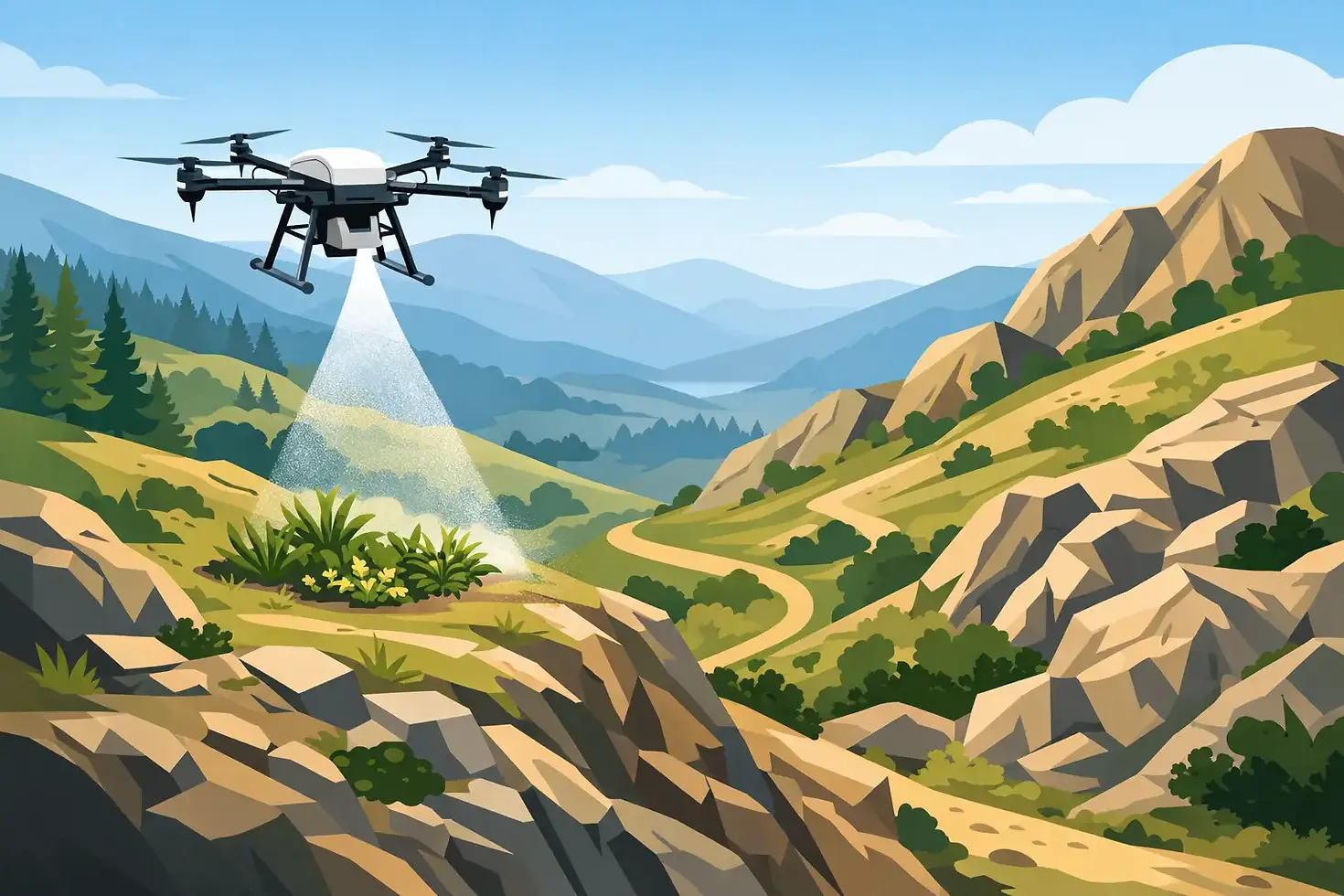
Spot Spraying by Drone on Tough Terrain
When blackberry is pushing through a steep gully or gorse is scattered across broken hill country, broadacre spraying often means treating more area than necessary. Spot spraying by drone changes that. It allows targeted application exactly where the problem sits, without sending staff into risky ground or trying to force machinery into places it does not belong.
For landowners and managers across Bay of Plenty and Waikato, that matters for two reasons. First, it saves time and chemical by focusing treatment on the actual weed pressure. Second, it opens up sites that are slow, unsafe or impractical to handle with knapsack crews, tractors or larger aircraft.
Where spot spraying by drone makes the biggest difference
The best use case is not every paddock or every block. It is the land where access is the real problem, or where precision matters more than blanket coverage. That includes gullies, stopbanks, drains, race edges, forestry margins, shelter belts, orchard boundaries and steep faces where weeds are patchy rather than uniform.
It is also well suited to public and commercial sites where the treatment zone sits close to assets, waterways, roadsides or sensitive vegetation. In those situations, being able to control droplet placement and apply only where needed is not just efficient - it is part of managing risk properly.
A drone can fly low, hold a consistent line and work into awkward sections without tyre damage, soil compaction or repeated foot traffic. On wet ground, that can be the difference between getting a job done this week or waiting until conditions improve while the problem spreads.
Why landowners are shifting from blanket spraying
Blanket spraying still has its place. If weed pressure is even across a large, accessible area, broadacre treatment may be the simpler option. But many properties are not that tidy. They have scattered infestations, changing contours and sections that are easy to miss from the ground.
That is where spot spraying by drone stands out. Instead of covering an entire block to catch isolated pockets, the operator can map or visually identify the target areas and treat those directly. Less overspray means less product wasted. It also reduces pressure on surrounding pasture, crops or non-target plants.
There is a cost angle here too. If only 15 per cent of a site needs treatment, paying to spray 100 per cent rarely stacks up. The exact economics depend on block size, travel, refill cycles and application rate, but selective treatment often makes better operational sense than a full-pass approach.
Precision is only useful if it is backed by the right setup
Drone spraying gets talked about as though the aircraft alone does the hard work. It does not. Good spot spraying depends on a combination of capable equipment, the right chemical plan, accurate calibration and an operator who understands both aviation and application.
Variable-rate capability matters because different targets need different outputs. Fine, scattered regrowth is not the same job as dense gorse or a hard-to-reach infestation along a bank. Height control, swath management and droplet size all influence whether the product lands where it should.
Conditions matter just as much. Wind, temperature, proximity to sensitive areas and the shape of the ground affect what is possible on the day. A professional operator will not pretend every site can be treated the same way. Sometimes the right call is to wait for a better weather window. Sometimes the right call is to break the work into smaller sections to maintain control and reduce drift.
Safety is one of the strongest reasons to use a drone
A lot of difficult weed work has historically involved people carrying packs across steep, slippery or overgrown country. That can be slow, tiring and exposed. The chemical risk is obvious, but so is the physical risk from falls, uneven ground and repeated handling.
Spot spraying by drone removes much of that exposure. The operator stays out of the treatment zone while the aircraft does the application. That reduces direct contact with chemicals and avoids sending staff into unstable or hazardous areas.
For councils, contractors, orchards and larger rural properties, this is often the deciding factor. It is not just about doing the same job with newer gear. It is about using a method that is safer by design, while still delivering practical coverage.
Better access changes what can be treated
Ground rigs are limited by slope, soil condition, crop layout and physical entry points. Even where access is technically possible, it may not be efficient. A ute and trailer can get to the gate, but not to the infestation halfway down a ravine or along a wet drain edge.
A drone does not need a formed track through the treatment area. It needs a safe launch and loading point, a compliant operating plan and enough room to work efficiently. That makes it a strong option for fragmented sites and blocks with multiple hard-to-reach pockets.
This is particularly useful on mixed-use properties, where one section may be easy pasture and another is rough country, scrub margin or orchard perimeter. Instead of applying one method across the whole site, drone work can be used where it gives the clearest advantage.
Spot spraying by drone is not always the cheapest option per hour
This is where a practical conversation matters. Drone work can save money overall, but it is not automatically the lowest hourly cost on every job. Small sites with simple access and light weed pressure may still be handled efficiently by a ground crew.
The value comes through when access is poor, labour demand is high, or non-target impact needs tight control. If a drone avoids days of manual work, reduces chemical use and gets the job done without damaging ground conditions, the total outcome is often better even if the hourly equipment rate looks higher at first glance.
That is why good operators price according to the job. Smaller spot work may suit an hourly model. Larger vegetation control programmes may work better on a per-hectare basis. The right approach depends on area, density, terrain and refill logistics.
Compliance and operator credentials matter
Anyone can talk about precision. The real question is whether the work is being carried out under the right aviation and chemical handling framework. That matters for farms, orchards, councils and commercial clients alike.
You want an operator who understands application rates, label requirements, weather limits, buffer management and how to document the job properly. Insurance, flight compliance and chemical certification are not extras. They are part of professional service delivery.
This is one reason clients across Bay of Plenty and Waikato use a specialist contractor rather than trying to treat drone spraying as a gadget purchase. A capable aircraft is only one part of the job. Planning, calibration and safe execution are where results are won or lost.
What a well-run job looks like
A proper spot spraying job starts with site assessment. The operator needs to know what is being targeted, how dense it is, what sits nearby and what constraints apply. From there, the work can be scoped around area, terrain, product choice and the most efficient loading setup.
On the day, treatment should be deliberate rather than rushed. The aim is accurate placement, not simply covering ground fast. That usually means flying to the conditions, watching drift risk closely and adjusting output where density changes across the site.
Afterwards, good records and clear communication matter. Clients should know what was treated, what was used and whether a follow-up pass is likely. Weed control is rarely a one-off fix, especially with tougher species or seasonal regrowth. A practical operator will tell you that upfront rather than overselling a single visit.
For many landowners, the biggest benefit is not just that the drone can spray. It is that the work can be done safely, accurately and without the usual access headaches. If you have steep country, awkward boundaries or isolated weed pressure that does not justify blanket treatment, spot spraying by drone is a method worth considering. And if it is handled by an experienced regional contractor such as Agrodrone, it becomes a straightforward way to protect pasture, crops and property without making a simple weed job harder than it needs to be.


Comments