

Drone Service for Biosecurity Weeds
- michaelvisser66
- Jun 1
- 6 min read
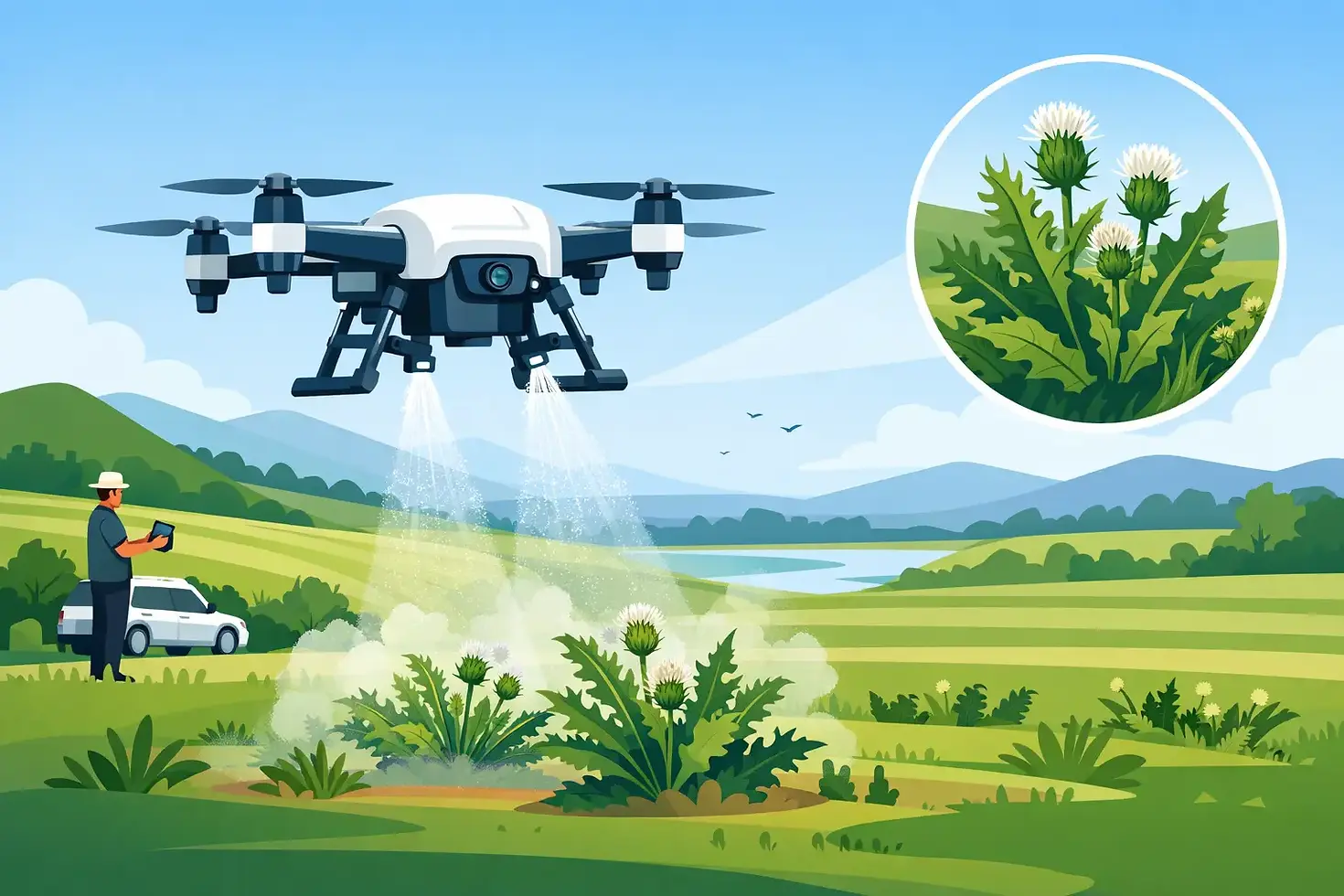
A biosecurity weed problem rarely stays small for long. One missed patch in a gully, along a fenceline, or beside a waterway can spread seed, choke productive land, and create a much bigger control job next season. That is where a drone service for biosecurity weeds makes practical sense - fast deployment, precise application, and safe access to ground that is awkward, steep, wet, or simply too slow to cover by hand.
For landowners, growers, councils, and site managers, the question is not whether pest plants need controlling. It is how to do it efficiently without blowing out labour, exposing staff to unnecessary chemical handling, or sending machinery where it should not go. Drone application gives you another option, especially when timing matters and access is the real constraint.
Why biosecurity weeds are hard to manage with conventional methods
Biosecurity weeds do not usually turn up in the easiest paddock with perfect access. They establish on margins, banks, drains, slips, riparian edges, forestry blocks, and rough country where ground rigs are limited and hand crews lose time just getting into position. In many cases, the infestation is scattered rather than uniform, which makes blanket treatment inefficient.
That creates a common problem. A ute, trailer unit, or tractor-mounted sprayer may suit open, trafficable ground, but it is often a poor fit for broken terrain or isolated outbreaks. Hand spraying can still be the right choice for very small jobs, but once the area grows or access becomes risky, the labour cost climbs quickly.
There is also the issue of consistency. Biosecurity weed control often depends on applying the right product at the right rate to the right target, while avoiding nearby pasture, crops, shelterbelts, waterways, or sensitive public areas. If the treatment is uneven, the weeds recover. If it is too broad, the off-target damage becomes its own problem.
Where a drone service for biosecurity weeds fits best
A drone service for biosecurity weeds is most useful where precision and access matter more than brute coverage. That includes steep faces, gullies, rough pasture, roadside margins, drains, retention areas, industrial land, orchard boundaries, and blocks where machinery would bog, mark the ground, or struggle to turn.
It is also well suited to spot treatment and patch management. Instead of driving across a full area or sending crews on foot over difficult country, a drone can be deployed to targeted zones and fly repeatable application paths over the infestation itself. That saves time and helps reduce unnecessary chemical use.
For councils and organisations managing pest plants across mixed terrain, this matters operationally. One contractor can reach multiple sites in a day, apply product accurately, and complete work without the same setup constraints as a larger ground-based operation. For farmers and orchard operators, it means weed control can happen without disrupting more of the property than necessary.
Precision matters more than spray volume
One of the biggest misunderstandings around aerial application is that more spray equals better control. In practice, biosecurity weed treatment is about coverage quality, droplet control, and keeping the application where it is meant to go.
Modern spray drones are built for controlled, low-altitude application. With the right setup, they can apply product at calibrated rates and adjust to the shape of the terrain far better than many conventional methods in hard-to-access areas. Variable-rate capability also allows the operator to respond to different infestation densities instead of treating every square metre the same way.
That has two direct benefits. First, it can reduce waste by avoiding over-application. Second, it helps lower the risk of drift and off-target impact when the job is planned properly around weather, buffer zones, and site conditions.
This is one reason certified operators matter. Drone spraying is not just about flying a machine. It is about understanding chemical handling, application rates, nozzle selection, site hazards, weather windows, and compliance requirements. On biosecurity work, especially near public land, waterways, or neighbouring properties, that level of control is not optional.
Safety is not a side benefit
For many properties, the strongest case for drone spraying is safety. Sending people into steep gullies, unstable banks, dense weed growth, or isolated blocks with spray packs is slow and physically demanding. Running machinery on slopes or wet ground brings its own risks, from rollovers to soil damage and access issues.
A drone keeps the operator away from the target area during application. That reduces direct chemical exposure and removes the need to physically carry equipment through rough terrain. It also limits the amount of vehicle movement across sensitive ground.
For commercial sites and public-sector work, that matters from a compliance and liability perspective as much as a practical one. A safer treatment method is often a more responsible one, provided it is carried out by properly certified and insured operators with the right procedures in place.
What a good drone spraying contractor should bring to the job
Not every drone operator is set up for vegetation management, and not every vegetation contractor has the aviation capability to do this well. For biosecurity weeds, you want a service provider that can manage both sides of the job - flying safely and applying agrichemicals correctly.
That means recognised aviation credentials, chemical handling certifications, and a clear understanding of application planning. It also means equipment designed for field use rather than hobby or camera work. Spray drones used in agriculture and vegetation control need stable payload performance, reliable flow control, and the ability to work accurately over uneven ground.
Just as important is the ability to price the work sensibly. Smaller spot-spraying jobs are often better handled on an hourly basis, while larger programmes usually suit per-hectare pricing. A capable contractor should be able to assess the site, explain the likely approach, and recommend the pricing model that matches the scale and complexity of the work.
Drone service for biosecurity weeds in real field conditions
In Bay of Plenty and Waikato conditions, weed control jobs often come with mixed terrain and mixed priorities. One property might need targeted treatment along a steep sidling above pasture. Another might have pest plants around orchard margins where ground access is tight and non-target vegetation needs protecting. A roadside or reserve job may require rapid treatment without bringing in heavier equipment that disrupts the site.
This is where drone spraying proves its value. It can be mobilised quickly, works well in awkward blocks, and gives clients a way to treat infestations before they spread further. The speed is useful, but the real gain is operational efficiency - less wasted movement, less unnecessary coverage, and less time spent trying to force conventional gear into unsuitable terrain.
Agrodrone is built around this kind of work, with certified drone application capability for properties and sites where safer, faster, and more accurate treatment is the priority.
That does not mean drones replace every other method. Open, flat, easily accessible ground may still be more economical with a boom sprayer or other ground equipment, depending on the scale. Likewise, very small isolated weeds may still be practical to handle manually. The right answer depends on terrain, infestation pattern, site sensitivity, and how urgent the job is.
When drone spraying is likely to save you money
Cost is not just about the hourly rate or per-hectare number. It is about the full job. If a conventional method takes longer, requires more labour, uses more product, or cannot reach the target area effectively, the cheapest-looking option on paper can become the expensive one in the field.
Drone spraying often makes the most financial sense when access is difficult, infestations are patchy, or timing is critical. It can also reduce the hidden costs tied to operator fatigue, repeated visits, machinery wear, and lost productivity elsewhere on the property.
For institutional clients, the value often sits in responsiveness and documentation. For rural clients, it usually comes back to speed, reduced hassle, and getting the weeds under control before they become a larger management problem.
The best time to deal with a biosecurity weed is when the patch is still manageable and the treatment window is right. If the ground is hard to reach or the usual methods are too slow, a drone service is not a gimmick - it is a practical tool that can get the job done properly.


Comments